Grand Jury urges San Francisco to refocus on Vision Zero
“While the city looks ahead to the future of Vision Zero, now is not the time to say we failed and back down, but to learn from our mistakes and make a real commitment to safer streets.”
I couldn’t agree more with this quote from Katherine Blumberg, chair of the Investigation Committee for the San Francisco Civil Grand Jury’s new report: Failed Vision: Revamping the Roadmap to Safer Streets.
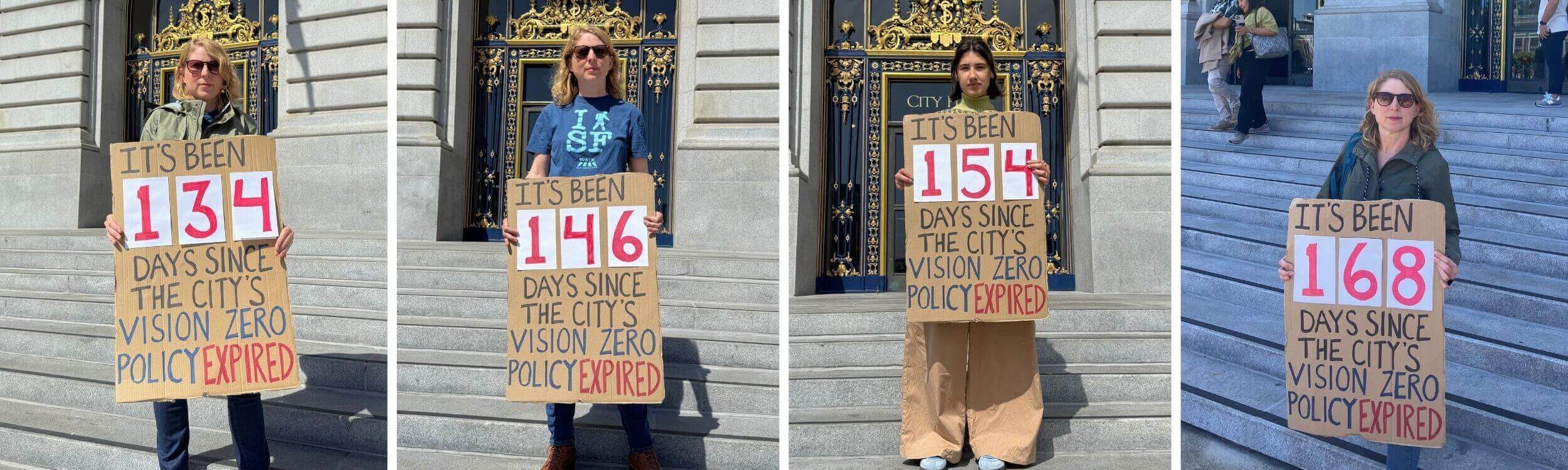
This report arrives with the City currently having no Vision Zero policy; it expired nearly six months ago. That’s why Walk SF keeps showing up at City Hall week after week. It’s unacceptable that there’s no commitment to or plan for traffic safety here, especially with 2024 the deadliest year in a decade when it comes to traffic crashes.
The report calls out some key challenges and opportunities for San Francisco to really move the needle in preventing severe and fatal crashes – and make Vision Zero a success story.
1. Traffic enforcement of the most dangerous driving behaviors matters.
The report goes into great detail on how the SF Police Department’s citations have dramatically dropped from a decade ago and the role that’s played in increasingly dangerous – and I’d call it antisocial – driver behavior.
In our recent letter to Mayor Lurie, we urge him to hold the SFPD to do their part for Vision Zero, with a focus on dangerous speeding, in an effective, efficient, and equitable way. San Francisco’s new speed camera program will make a big difference on streets with cameras, but we need the SFPD to play a crucial, complementary role on the streets with the worst speeding issues that don’t have cameras. This will support a broader behavior shift by drivers.
2. Streets are not sufficiently designed for safety across our city.
The report calls out the important progress that the SFMTA has made in the past decade, but the “SFMTA needs to be more efficient and timely in identifying and implementing much-needed safety improvements for city streets.”
Yes. We need more solutions applied at the scale needed to make a difference, and it’s simply taking too long for this to happen. As mentioned in our letter to Mayor Lurie, many proven tools to prevent crashes (and especially pedestrian injuries) like ‘turn calming’ are seriously underutilized – despite being very affordable.
The report, like our letter to Mayor Lurie, calls out needing a new approach to bringing speed humps and cushions to streets in a proactive, neighborhood-scale way instead of the existing Residential Traffic Calming Program. Like speed cameras, speed humps and cushions work 24-7 to change driver behavior.
The report also calls out something that’s on our agenda: adding protection to ‘daylighting’ on the high-injury network. Right now, the SFMTA is painting daylighting at all intersections in San Francisco in support of the new state law, which is fantastic.
But we know that when there’s only paint, some drivers will illegally park there, which means the crucial visibility that daylighting creates is lost. Protective posts that prevent parking in the daylighting zone are needed on the streets with the highest rates of crashes. You can email City leaders your support for protected daylighting here.
The report mentioned that the Department of Public Health (DPH) is developing a “high-risk network.” This sounds like a helpful additional tool, but we must call out that DPH hasn’t released an updated “high-injury network” since 2022 (the high-injury network is based on crash data from the SFPD and hospitals). The high-injury network is a core part of the City using a data-driven approach to prioritizing where changes are needed.
Our letter to Mayor Lurie also asks for him to ensure DPH does timely analysis in support of Vision Zero. So many of the streets on the high-injury network desperately still need to be redesigned. The City must not lose sight of that.
3. Make the City’s Vision Zero efforts more transparent, with performance metrics and a public dashboard.
Right now, the public cannot see progress; all we know is that we’re not yet at zero. When the public can see comprehensive plans and outcomes-based metrics, there will be greater support and understanding of the City’s good work and progress on Vision Zero.
The report calls this out, and refers to New York City’s metrics. We think Washington, DC is a role model, too, with a range of performance indicators around vehicle speeds, driver yield rates, reductions in conflicts/near-misses at intersections, and more.
San Francisco needs a public dashboard that shows progress towards safe streets objectives that will get to Vision Zero. This is a fundamental tool for good government, but also can help drive the work forward.
And again, right now, there’s no policy or plan for what each agency is committed to do in the next few years with respect to traffic safety.
The report is missing the role of City agencies beyond the SFPD and SFMTA.
The most important thing missing from the report is the role of agencies beyond the SFPD and SFMTA. The most successful Vision Zero cities take a true interagency approach to traffic safety. Here in San Francisco, the DPH is one, but so is the Department of Public Works (which does street paving, curb cuts, sidewalks, and more) and the SF Fire Department (which gets to weigh in on street redesigns).
Beyond that are all City employees who drive while on the job. The Budget and Legislative Analyst has found that excessive, recurring, and dangerous rates of speeding are happening in City vehicles driven by City employees (all of which have ‘telematics’ installed, except emergency and police vehicles). Yet no meaningful steps beyond reporting have been taken at agencies to address this. Our letter to Mayor Lurie also asks him to hold agencies accountable on dangerous speeding. City employees must stop contributing to the #1 cause of severe and fatal crashes in San Francisco.
We need Mayor Lurie to lead.
How safe our streets affect all of us, every single day. And Vision Zero is still the right approach – but it can only succeed with real leadership and meaningful actions.
That’s why we’re asking Mayor Lurie to recommit the City including all core agencies to Vision Zero by July 30, and adopt a detailed plan by September 30 for what each agency will deliver in the next three years. Vision Zero can be a success story.
If you’ve read this far, you care a lot about safe streets. Please: email Mayor Lurie right now to echo our asks!