How California’s speed safety camera law protects data and privacy
Walk SF has been a strong advocate for speed cameras for more than a decade.
We worked with crash victims for eight years to pass state legislation allowing this proven technology in California. In 2023, Governor Newsom signed Assembly Bill 645 allowing San Francisco and five other California cities to pilot speed cameras.
With San Francisco’s speed camera pilot program proving incredibly successful in changing driver behavior, we want to expand San Francisco’s program plus allow other California cities to be able to use this lifesaving solution.
Because Walk SF is very vocal in our support for speed cameras, we’ve gotten questions from people about whether these work like Flock cameras do. In short, absolutely not.
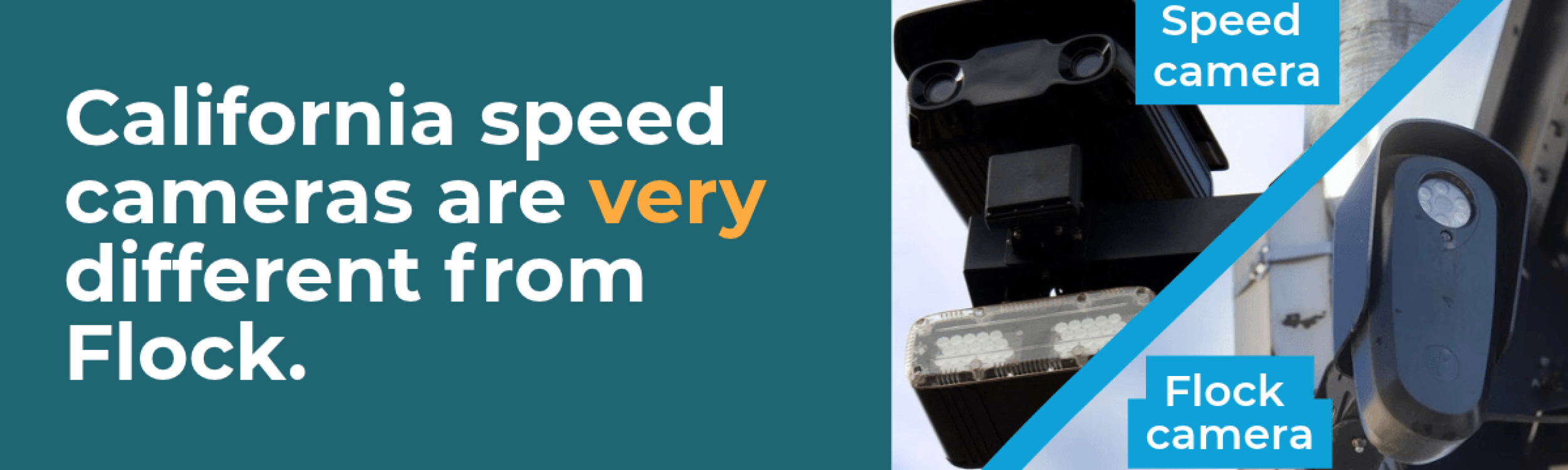
Speed cameras differ enormously from license plate reading systems like Flock. The state law, AB 645, makes sure of this. Read on to see the fundamental differences between how California’s speed camera program works to protect data and privacy and how Flock cameras work.
Issue |
California Speed Safety (AB 645) |
Flock Automated License Plate Reader (ALPR) Cameras |
|
|---|---|---|---|
| Trigger Mechanism | Only if a violation occurs: Cameras are triggered only when a vehicleexceeds the posted limit by at least 11 MPH | Captures all vehicles: Captures all passing vehicles regardless of driver behavior or suspicion. | |
| Image & Data Captured | Rear plate and vehicle rear only: Specifically prohibits photographing the windshield, driver, or vehicle occupants. | Full vehicle profile: Captures license plates; details like vehicle make/model/color, bumper stickers, dents, and roof racks (generating a “Vehicle Fingerprint”). | |
| Facial Recognition | Explicitly banned: Prohibits the integration or use of any facial recognition software. | AI-enabled tracking: While Flock ALPR cameras do not use facial recognition, Flock’s AI models can be used to profile vehicle aesthetics and characteristics to track vehicles across time and place. | |
| Data Retention | Strict, short-term limits: Records not resulting in a citation are automatically deleted within 5 business days; records resulting in a citation must be purged within 60 days after final disposition of the notice of violation. | Prolonged retention allowed: Local agencies and private entities contracted with Flock can decide how long they want data kept. Under current San Francisco policy, Flock keeps data for 30 days and then transfers it to SFPD, which can retain data for up to 1 year. | |
| Administering Body | NOT administered by law enforcement: Must be managed by local transit and/or public works agencies (e.g., SFMTA, LADOT, Oakland DOT) rather than police departments. In San Francisco, the speed camera program is administered by the SFMTA. Data is stored for SFMTA use only and cannot be shared with any other agency unless court-ordered to do so. | Law enforcement & private entities: Managed by police departments, sheriffs, private HOAs, property managers, and retail complexes. Even individual homeowners can purchase Flock cameras. | |
| Interagency Data Sharing | Strictly prohibited: Data cannot be shared across state or federal databases, with immigration enforcement (DHS, ICE, etc.), or with out-of-state entities, except under rare, court-ordered subpoenas. | Allows nationwide data sharing: Cameras can be connected to regional and national data-sharing systems, allowing cross-agency data sharing across jurisdictional and state lines if agencies/customers enable it. |
Banner image: Fiona Yim, Getty Images
