Five reasons 2025 can be a turning point for safe streets in San Francisco
“More people died in San Francisco from traffic crashes than homicides in 2024.”
That was the headline in the San Francisco Chronicle on December 30.
A total of 42 people were killed in traffic crashes in San Francisco last year, the highest number since 2007.
Of the 42 people who died, 24 were pedestrians, the highest number in a decade. Four were the family waiting for the bus in West Portal: Diego Cardoso de Oliveira; Matilde Moncado Ramos Pinto; Joaquim Ramos Pinto de Oliveira; and Cauê Ramos Pinto de Oliveira.
2024 was such a heartbreaking year.
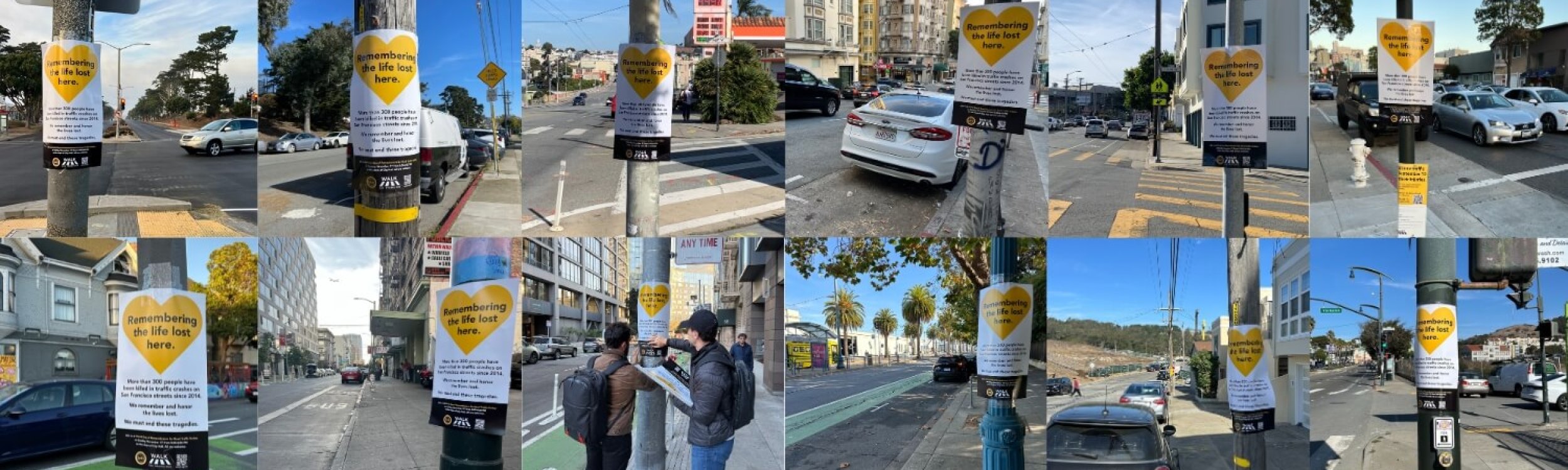
In November, with the help of volunteers, we posted memorial signs at the 317 fatal crash locations over the past decade. For a few days, you couldn’t go anywhere in the city without being reminded of the human toll of unsafe streets. And this doesn’t even capture the more than 500 people severely injured in traffic crashes each year.
Yet I look to 2025 with optimism. I believe that 2025 can be the turning point for ending these tragedies – and becoming a city where our streets are places of safety, joy, and connection. Here’s why.
1. Speed cameras will be up and running in March.
Walk SF worked for six years to pass legislation allowing San Francisco to pilot this technology for good reason. Speed cameras are a powerful, proven tool to help take on the #1 cause of severe and fatal crashes on our streets.
I’m confident these cameras will change driver behavior, and there will be notably fewer crashes at and near the 33 speed cameras. But we need driver behavior to change everywhere.
If the City takes additional actions this year and adopts a comprehensive approach to reducing speeds, speed cameras could be the start of San Francisco becoming what we call a ‘safe speeds city.’ This would prevent tragedies, but also make our streets less stressful, our neighborhoods more enjoyable, and our air cleaner.
2. Mayor Daniel Lurie appointed Alicia John-Baptiste as Chief of Infrastructure, Climate, and Mobility.
When we got word of this appointment on Tuesday, we celebrated what it means for safe streets and sustainable transportation.
Not only does John-Baptiste believe in prioritizing people over cars on our streets, John-Baptiste has worked at the SFMTA and the SF Planning Department. This makes her uniquely positioned to understand how to get agencies working together more efficiently so that redesigning streets happens a lot faster and meets the highest bar for safety.
Having John-Baptiste in this brand-new position holds a lot of promise. She’ll also be in a great position to make safe streets a core part of how Mayor Lurie delivers a better San Francisco.
3. The City will adopt a new Vision Zero policy and plan in 2025.
With a decade having passed since San Francisco first committed to Vision Zero – a data-based, preventative approach to end severe and fatal traffic crashes – it would be easy to write this approach off given the number of traffic deaths in 2024. That would be a mistake.
Vision Zero remains the right goal and approach because solutions exist to make our streets safer. But solutions must be layered and brought to scale for Vision Zero to become a reality.
I think about the Tenderloin neighborhood. In the Tenderloin, the speed limit is now 20 MPH on every street. Every intersection has no-turn-on-red, and pedestrian safety zones ensure visibility for drivers, shorten the crossing distance for pedestrians, and force drivers to turn slowly. The deadliest streets have been redesigned, with lanes removed to calm traffic and reduce speeding. And the Tenderloin is seeing fewer people hurt and killed in traffic crashes.
In fact, where San Francisco has done major Vision Zero projects, it’s working. An evaluation of 28 Vision Zero projects showed that traffic collisions decreased by 16% at these locations, including a decrease in pedestrian-related collisions of 35%. The City must build on this – at scale.
Last year, Walk SF and the 30+ groups in the Vision Zero Coalition developed detailed recommendations on how San Francisco can accelerate Vision Zero progress. We’re building on this to help Mayor Daniel Lurie and Alicia John-Baptiste direct what’s next for Vision Zero so it can become a success story this decade.
4. ‘Daylighting’ at intersections is now state law.
A new state law means it’s now illegal for all drivers everywhere in California to park within 20 feet of any marked or unmarked crosswalk at the corners where their vehicle is facing the crosswalk. Called ‘daylighting,’ this reduces crashes by up to 30% by increasing visibility for both drivers and people outside of vehicles.
Until this law, most streets have allowed parking up to the corner (unless red ‘no parking’ paint indicated otherwise), reducing crucial visibility for drivers and pedestrians. For years, Walk SF has advocated for the City to embrace daylighting citywide – and now it’s actually the ! Yet because most drivers don’t know about the law and are used to parking up to the curb, the City must do more for this to translate into actual daylighting. That’s why we’re asking for key actions in support of daylighting.
Last month, the Board of Supervisors unanimously passed a resolution urging the SFMTA to add red ‘no parking’ paint to all intersections in support of the daylighting law so that drivers heed it (and avoid tickets). The SFMTA will share plans for how it will do this at the January 21 SFMTA Board meeting; you can join us there to show your support for safe intersections and demand the fastest-possible timeline for adding ‘no parking’ paint.
5. More people than ever share our vision for safe streets.
I’m also optimistic because more people than ever share our vision for a San Francisco where streets are places of safety, joy, and connection rather than fear and tragedy.
The fact that the majority of voters supported both JFK Promenade and Ocean Beach Park are positive indicators, as is the fact that San Franciscans are eager and excited for speed cameras. The Board of Supervisors overwhelmingly supports Vision Zero and is ready to demand faster progress, and they are a reflection of what San Franciscans care about. And every day, the Walk SF staff meets and hears from more people who see the problem and want solutions.
So let’s build on these five opportunities together. Let’s make 2025 the year we look back on as San Francisco’s turning point in becoming the nation’s safe streets leader.
The stakes couldn’t be higher, as we face larger, heavier, more powerful vehicles on our streets – and more dangerous driving behavior threatening our very lives. It will take all of us showing up and speaking up, but there’s no time like right now to get started. These are our streets and our city’s future.
I’m so grateful to Walk SF members who financially support us so we can do the policy, advocacy, and organizing work to win. I’m also so thankful to the many folks who speak public hearings, support our fundraising events like Peak2Peak and the SF Stair Challenge, and stand with victims at vigils and World Day of Remembrance for Road Traffic Victims.