It’s been one year since speed camera legislation became law. Here’s the latest.
As we have been reflecting on Governor Newsom’s veto of SB 961, something very much related keeps coming up: Walk SF’s six-year campaign to pass legislation allowing speed cameras to be used in San Francisco.
Our successful campaign for speed cameras took a lot of tries – but we ultimately got there, with a statewide coalition, the voices of Families for Safe Streets members, legislative champions, and leadership from our City leaders.
October 13 was the one-year anniversary of Governor Newsom signing the speed camera bill, AB 645. Los Angeles, San Jose, Oakland, Glendale, and Long Beach – to pilot the use of speed cameras.
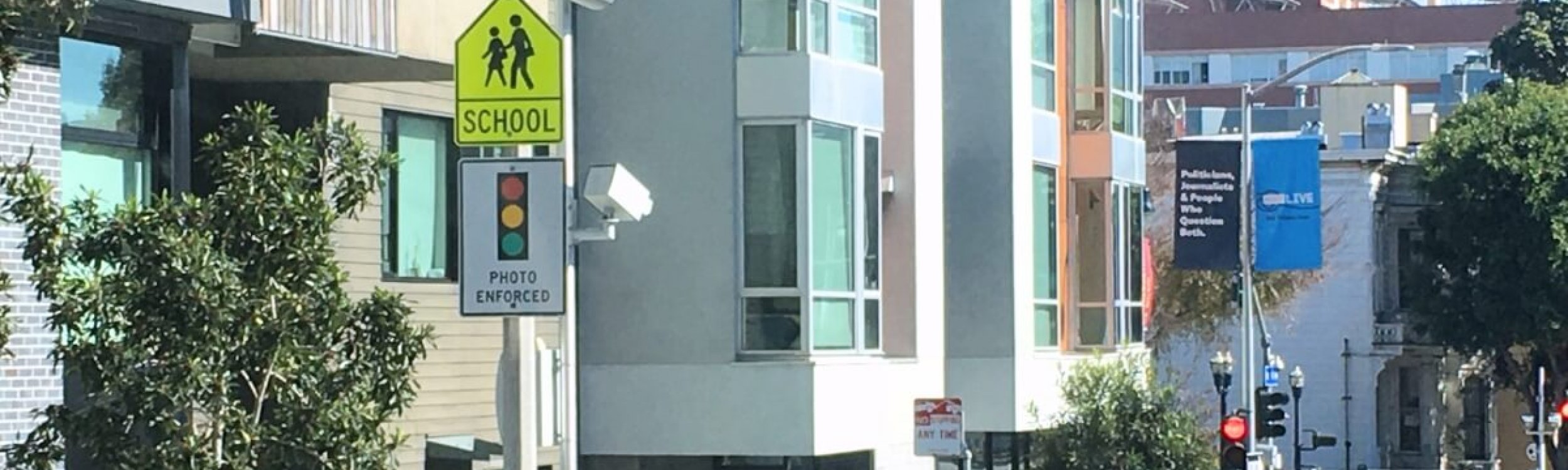
San Francisco is on track to launch 33 speed cameras in February 2025, and be the first of the six cities in California to do so.
Earlier this week, the SFMTA Board of Directors approved a contract with Verra Mobility to implement speed cameras. Locations for the 33 cameras were finalized in the spring.
Walk SF is grateful to the SFMTA for working quickly to bring this lifesaving tool to our streets ASAP. Speed cameras are a powerful and crucial tool to help counteract the epidemic of speeding.
The speed camera pilot program has the potential to usher in a new era for safe speeds – and save countless lives. But the City must take additional actions at the same time so that driver behavior shifts at a much broader scale than the locations of the 33 speed cameras. Because we need drivers to slow down everywhere!
Walk SF continues to push for additional actions by the City to amplify the effect of speed cameras. This includes:
1. Continue lowering speed limits on every eligible street in San Francisco. San Francisco now has the legal authority to lower speeds by 5 MPH on all high-injury streets, and we need them to max out their authority. The SFMTA has been lowering speed limits on commercial corridors to 20 MPH, but lower limits are still the exception rather than the norm. We especially need SFMTA to fast-track lowering limits on high-injury streets with 30 MPH and 35 MPH limits.
2. Bring speed-slowing solutions to scale across the high-injury network. We need turn calming at hundreds of intersections, traffic light timing for safe speeds on every high-injury street, and proactive installation of speed humps and cushions across neighborhoods.
New York City now has turn calming at 931 intersections, where it’s reduced pedestrian injuries by 20%. Left turn calming is inexpensive and easy to install. Rubber bumpers and/or posts are strategically placed in an intersection and to navigate these, drivers must slow down. Here in San Francisco, left-turning vehicles pose one of the biggest threats to pedestrians. The SFMTA must bring turn calming to hundreds more dangerous intersections.
Meanwhile, the SFMTA has been a leader in setting traffic signal timing to encourage safe speeds. Lights can be set to a certain speed, such as 20 MPH, and then drivers going that speed are rewarded with a predictable, continuous green light (called a “green wave”). This is particularly effective in bringing down speeds. Every high-injury corridor that hasn’t had signals retimed for safe speeds needs these, starting with all one-way streets.
San Francisco has installed about 900 speed humps and about 300 speed cushions in the past 20 years. Boston recently retooled its approach in a way we think SFMTA could mimic. Boston now adds ‘vertical speed reducers’ where data show they’re needed and in support of a broader speed strategy – and does not take requests anymore. This “by right” approach means vertical speed reducers can be installed faster and more strategically.
We also know the widest streets with 4+ lanes are where drivers go the fastest. The City needs to keep redesigning the widest, deadliest streets to keep speeds in check.
3. Get the message across to drivers in many ways that San Francisco is a safe speeds city.
Why do drivers go slower? The biggest determinant is street design. Beyond that, drivers slow down because: 1) they don’t want to get a ticket; 2) driving norms nudge them in the right direction (human behavior is contagious); or 3) they understand the serious dangers of speeding.
The San Francisco Police Department also must focus their limited traffic enforcement capacity on dangerous speeding, and in a way that complements speed cameras. Speed radar signs can supplement actual speed cameras, and savvy marketing can help get drivers to see how they can be part of the solution by slowing down.
Walk SF’s #SlowOurStreets campaign will push for every possible solution to bring down dangerous speeds across our city in 2025.