What’s next with the Street Safety Act & Initiative
We ended 2025 with two wins to bring safe streets into greater focus for city leaders and agencies.
First, there was the unanimous passage of the Street Safety Act by the Board of Supervisors on September 28. Then, on December 15, Mayor Lurie signed an executive directive, the Street Safety Initiative.
Both the Street Safety Act and Street Safety Initiative include key actions for agencies to accelerate progress in ending severe and fatal traffic crashes.
But now agencies must make these actions happen.
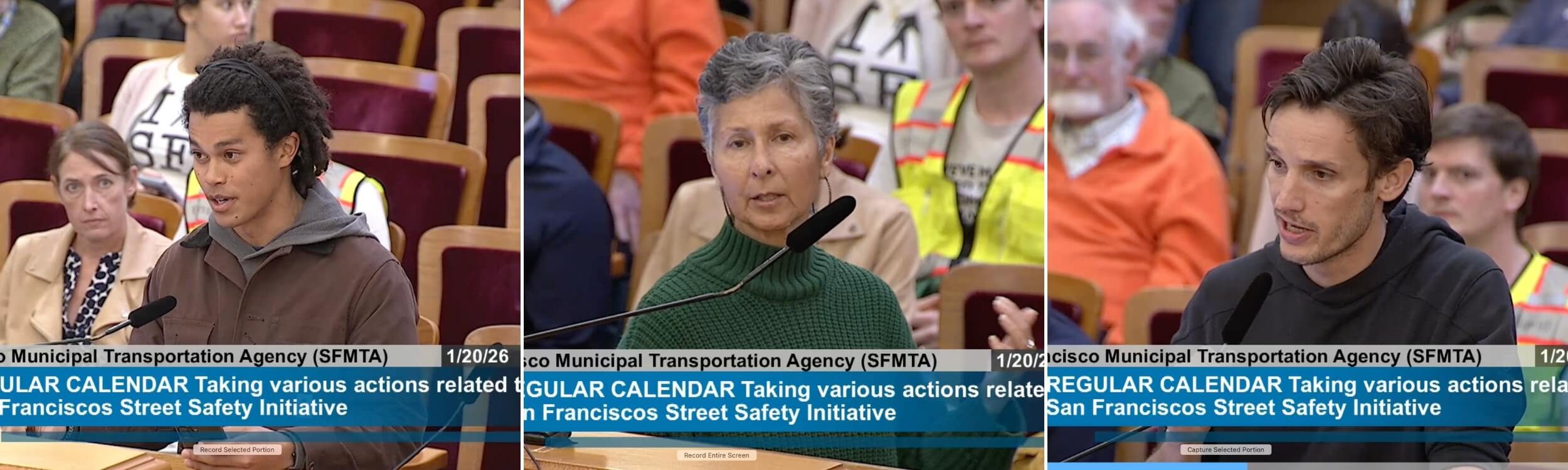
On Tuesday, Walk SF and some of our members went to the SFMTA Board meeting. The Board was voting to adopt what’s in both the Street Safety Act and Initiative, plus what the agency plans to accomplish in the next 18 months on safe streets.
We found these plans to be insufficient, and urged the SFMTA Board to ask for more from the agency. Disappointingly, the 18-month commitments were passed with no changes. Proposed efforts are modest, and don’t scale up solutions as needed.
The areas we’re most concerned about are:
- Quick Builds: The SFMTA’s commitment for the next 18 months is “8 projects through approval process.” Approval – not completion. Meanwhile, streets like Gough, Franklin, Harrison, 9th, 10th and Bryant that have been deadly for years still await safety redesigns.
- Daylighting: The SFMTA’s commitment for the next 18 months is to “Focus on all new 2025 HIN intersections, institutional land uses and beyond.” This is not in line with the previous commitment by the SFMTA to complete universal daylighting by the end of 2026. There also wasn’t any commitment to begin planning for hardening daylighting on the High-Injury Network, which is in the Street Safety Act.
- Residential Traffic Calming Program: The SFMTA’s commitment for the next 18 months is to “Release an updated Traffic Calming Program.” This program has been inequitable and inefficient for years and Walk SF has been advocating for a complete overhaul.
- Intersection Safety: The SFMTA’s commitment for the next 18 months is to add core intersection safety tools and signal changes to all new 2025 High-Injury Network (HIN) streets.” This could be an ambitious and laudable commitment – or not. There’s no knowing since the new HIN isn’t available yet. If the new HIN is very similar to the 2022, this would mean that little additional safety work would be done by the SFMTA. And low-cost, highly-effective ‘turn calming’ and pedestrian safety zones are not yet considered “core intersection safety tools.”
While we know the SFMTA has funding constraints, the cost of inaction is incredibly high, especially when people are hurt and killed. And the SFMTA knows that when they invest in safety projects, it pays off. The analysis shared at the meeting stated that on streets where Quick-Build safety projects have been completed, the annual bike-related crash rate decreased by 33% and the annual pedestrian-related crash rate decreased by 32%. Now’s the time to double-down on solutions, not tread water.
The good news is that the SFMTA must go back to the Board once the new High-Injury Network is released within the next 2 months to revisit the workplan in light of the new data. This will be an opportunity to push for more again. The High-Injury Network is also how the SFMTA can see where interventions are most urgently needed, and at the core of taking a safe systems, data-driven approach.
Walk SF will keep finding every opportunity to fight for more so that the SFMTA – and all agencies – meet or exceed what’s laid out in the Street Safety Act and Street Safety Initiative.
So as always, our advocacy together is crucial and continues. We’ll keep you posted on ways you can show leaders that safe streets are imperative, as is real progress.
Thank you to everyone who came to City Hall with us this past Tuesday, plus those who emailed the SFMTA Board before the meeting. We’re so grateful to our community for showing up and speaking out at these key moments!